It’s been a busy month. Two weeks ago we opened our doors to guests from America, showing them the programs here at WPC and taking them on site visits. This included facilitating our Earthquake Relief program in the VDC of Namtar, distributing blankets to numerous earthquake victims who are currently living in temporary housing.
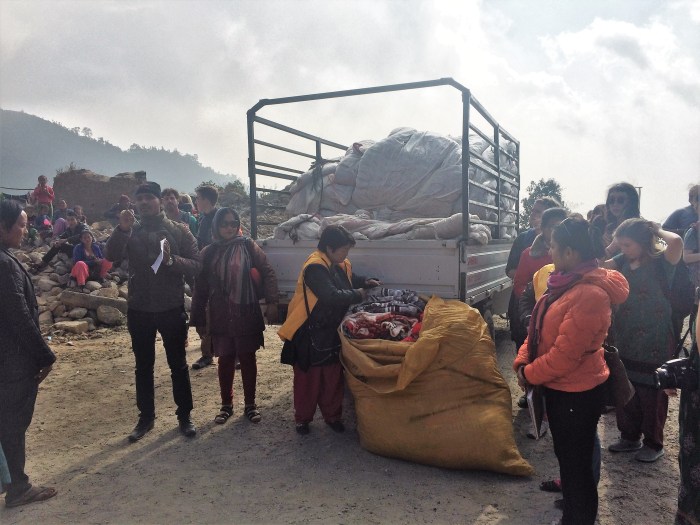
After their departure, Ram Sir and I were ready to get to work on our program delivery. We planned to reach the outskirts of the district this week covering three different VDC’s, Namtar, Daman, and Palung.
Reflecting back, I feel so full of accomplishment. After months of preparing and piloting, our goal of educating rural children on their rights is coming to fruition. We spoke to about 100 students in grades 8 and 9 and gave them the knowledge they need to be the change in their communities. In the process, we build relationships with 3 school districts where we could warmly return in the future. Tears are filling my eyes writing this as I know in my heart we have left a lasting impact on these students, preparing the next generation with truth and methods to protect themselves from harm. With a few schools under our belt at this point, I have made a few observations I’d like to share.
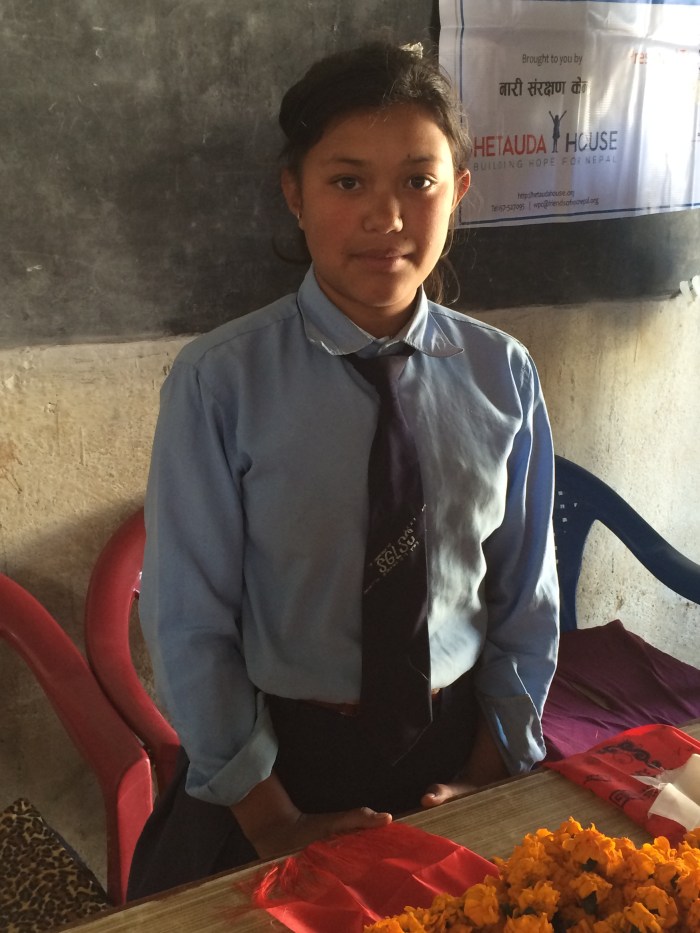
Every school has their own way of greeting guests. This past week we have been given bouquets of handpicked flowers, graciously accepted warm tea, and blessed with honorary scarves and strands of marigolds. Each school is a new surprise as they share their excitement to open their doors to guests teaching a topic that most teachers passionately support. At the school in Palung, the 8th grade student who is the President of Child’s Club set up a whole welcoming ceremony for us. As Nepali’s would say “Guests are our Gods”. I sure felt that way.


It is possible to facilitate an interactive class even though that is not Nepal’s traditional teaching style. We were warned as we revamped our materials that students may not respond well to our attempts to have them answer questions out loud and perform brainstorming activities as typically Nepali classes use memorization as their primary learning strategy. Teacher primary goal is to have students pass state exams. In fact, in government school 10th grade is commonly dedicated to exam preparation and is often just a supervised self-study hall. So when we added new activities and interaction to our material the explanation and warming students up was critical. It took a few tries but we found that breaking into small groups and completing activities on large pieces of paper to share with the class is great way to influence involvement.


Nepali students can sing! As an intermission activity, our trainer surprised us by asking one or two students to perform a song or dance for the class. This has easily become my favorite part and I am so enamored by their abilities in the arts. We even had one girl tell a joke in Nepali that I felt was a good representation of the focal points of Nepali culture that goes a little something like this: A man proposed to his girlfriend and she replied in English “I love you”. Confused, the boy walked away sad and sought a friends assistance to translate. He asked his friend, “What does ‘I love you’ mean?” In Nepali he replied “Maya garchhu”[I love you]. The boy replied, “Maya garchhu too, but what does ‘I love you’ mean?” The class was in hysterics. I sat confused until it was translated, as usual.

Being flexible and able to improvise is key. Planning has not been perfect this week, starting with day one. Our transportation was now unavailable so we had to take our motorbike (and find gas for it…). Because of this, we planned to travel three hours to the school then return home that evening, rather than carrying onward. However the ride was difficult and tiring and the temperatures were dropping so after our presentation we chose to press on, moneyless and gasless, to the next village where we planned to teach the following day. Choosing not to stress, we rode our bike in neutral and coasted our way into town, phoned a friend and wired money, and exchanged hi-fives rather than freak-outs.
In another example, the electricity went out during our presentation (and again as I type this), cutting power to our projector. Without a flinch, our facilitator spun the computer around, my coworker wrote a few questions on the board, and I sat back and smiled. The show went on and no one blinked.
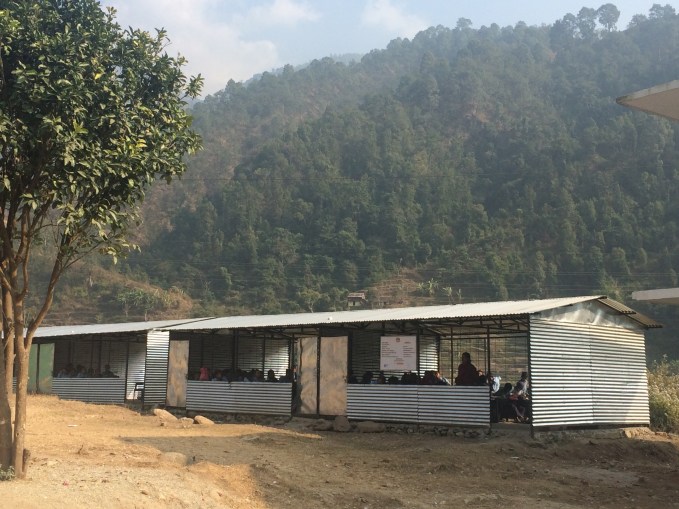
Temporary schools are frigidly cold. Many of the schools we have taught at are currently using temporary buildings. After the earthquake hit, the Nepali Emergency Response team visited all governmental buildings and performed an inspection to determine the safety of the building. Those considered safe were awarded a green dot and those condemned were assigned a red dot and temporary metal buildings or tent like structures were installed. Sadly during the winter season, these structures provide no installation and often are not even equipped with an electrical line to light the room. Even while teaching our class I found difficulty focusing in the freeze temperatures and wrapped myself tightly in all the layers I had with me. My heart went out to the students in the room, especially as most were wearing flip flops.
Riding a motorbike is a blast. As our bus was unavailable, traveling to the next school required extended periods of time on the back of a bike. Ram, Shankar and I traveled like our own bike gang up and down Nepal’s rolling hills admiring the beauty of the changing flora as we rose in elevation. We left the banana trees and jungles and climbed up to various firs and terraced farmlands carved steeply between sparse homes. Even with the wind chill, a huge grin spread across my face as I gave my eyes a mini vacation from the office walls.
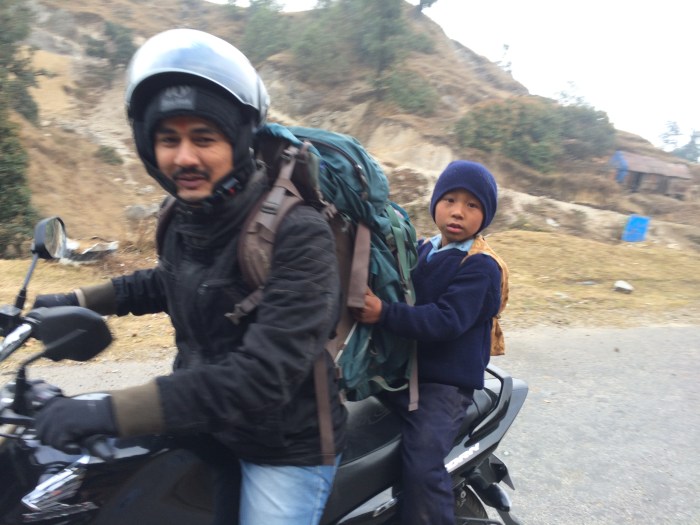
As we left a school in Namtar, we invited a young boy to accompany us on the back of the bike rather than walk home. He, like most others from this school, was mentally preparing for a two hour walk home on the opposite side of the hill. He does this every day. When I was his age I was fighting for the back seat of the bus or waiting from my mom to pick me up from soccer practice. One time I ran home with a friend to her house after school and remember it being brag-worthy – yet that was half the distance this child was traveling. If we had fuel all three of us would have eagerly been taking trips back and forth that evening.
 Journeying Jennifer