A Digest of Recent Events

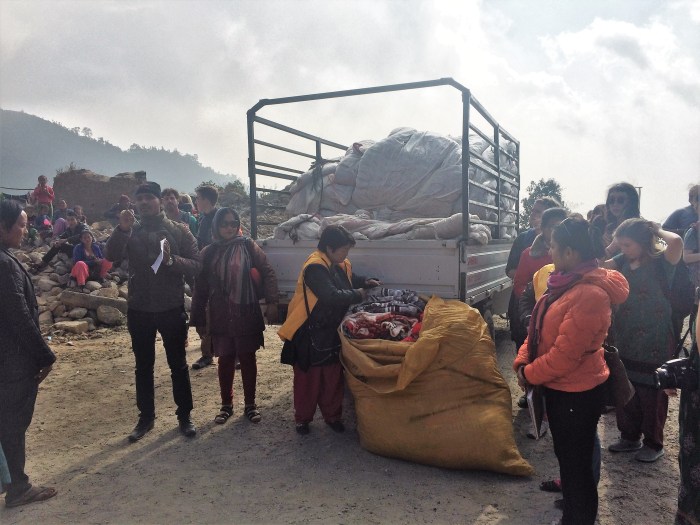
It’s been a busy month.  Two weeks ago we opened our doors to guests from America, showing them the programs here at WPC and taking them on site visits.  This included facilitating our Earthquake Relief program in the VDC of Namtar, distributing blankets to numerous earthquake victims who are currently living in temporary housing.
IMG_8081


After their departure, Ram Sir and I were ready to get to work on our program delivery.  We planned to reach the outskirts of the district this week covering three different VDC’s, Namtar, Daman, and Palung.

Reflecting back, I feel so full of accomplishment.  After months of preparing and piloting, our goal of educating rural children on their rights is coming to fruition. We spoke to about 100 students in grades 8 and 9 and gave them the knowledge they need to be the change in their communities.  In the process, we build relationships with 3 school districts where we could warmly return in the future. Tears are filling my eyes writing this as I know in my heart we have left a lasting impact on these students, preparing the next generation with truth and methods to protect themselves from harm. With a few schools under our belt at this point, I have made a few observations I’d like to share.

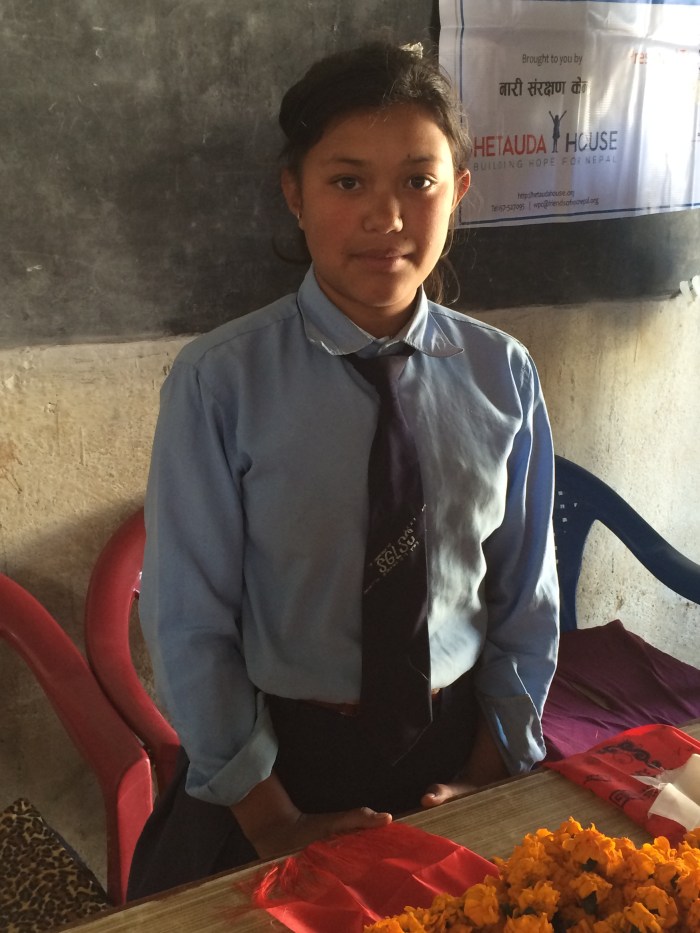
Every school has their own way of greeting guests. This past week we have been given bouquets of handpicked flowers, graciously accepted warm tea, and blessed with honorary scarves and strands of marigolds. Each school is a new surprise as they share their excitement to open their doors to guests teaching a topic that most teachers passionately support. At the school in Palung, the 8th grade student who is the President of Child’s Club set up a whole welcoming ceremony for us. As Nepali’s would say “Guests are our Gods”. I sure felt that way.

OLYMPUS DIGITAL CAMERA

IMG_8013IMG_8206


It is possible to facilitate an interactive class even though that is not Nepal’s traditional teaching style.  We were warned as we revamped our materials that students may not respond well to our attempts to have them answer questions out loud and perform brainstorming activities as typically Nepali classes use memorization as their primary learning strategy. Teacher primary goal is to have students pass state exams.  In fact, in government school 10th grade is commonly dedicated to exam preparation and is often just a supervised self-study hall. So when we added new activities and interaction to our material the explanation and warming students up was critical. It took a few tries but we found that breaking into small groups and completing activities on large pieces of paper to share with the class is great way to influence involvement.


Nepali students can sing!   As an intermission activity, our trainer surprised us by asking one or two students to perform a song or dance for the class. This has easily become my favorite part and I am so enamored by their abilities in the arts. We even had one girl tell a joke in Nepali that I felt was a good representation of the focal points of Nepali culture that goes a little something like this: A man proposed to his girlfriend and she replied in English “I love you”. Confused, the boy walked away sad and sought a friends assistance to translate.  He asked his friend, “What does ‘I love you’ mean?” In Nepali he replied “Maya garchhu”[I love you]. The boy replied, “Maya garchhu too, but what does ‘I love you’ mean?” The class was in hysterics.  I sat confused until it was translated, as usual.

IMG_8136


Being flexible and able to improvise is key. Planning has not been perfect this week, starting with day one. Our transportation was now unavailable so we had to take our motorbike (and find gas for it…). Because of this, we planned to travel three hours to the school then return home that evening, rather than carrying onward. However the ride was difficult and tiring and the temperatures were dropping so after our presentation we chose to press on, moneyless and gasless, to the next village where we planned to teach the following day. Choosing not to stress, we rode our bike in neutral and coasted our way into town, phoned a friend and wired money, and exchanged hi-fives rather than freak-outs.

In another example, the electricity went out during our presentation (and again as I type this), cutting power to our projector. Without a flinch, our facilitator spun the computer around, my coworker wrote a few questions on the board, and I sat back and smiled.  The show went on and no one blinked.


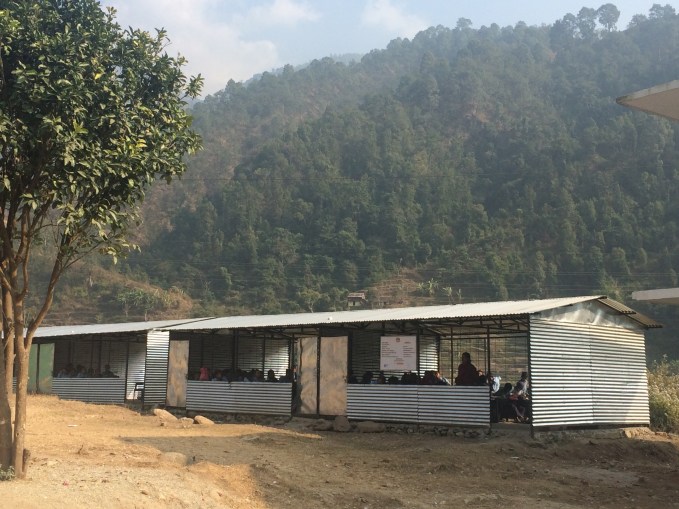
Temporary schools are frigidly cold. Many of the schools we have taught at are currently using temporary buildings.  After the earthquake hit, the Nepali Emergency Response team visited all governmental buildings and performed an inspection to determine the safety of the building.  Those considered safe were awarded a green dot and those condemned were assigned a red dot and temporary metal buildings or tent like structures were installed.  Sadly during the winter season, these structures provide no installation and often are not even equipped with an electrical line to light the room. Even while teaching our class I found difficulty focusing in the freeze temperatures and wrapped myself tightly in all the layers I had with me.  My heart went out to the students in the room, especially as most were wearing flip flops.
IMG_8024


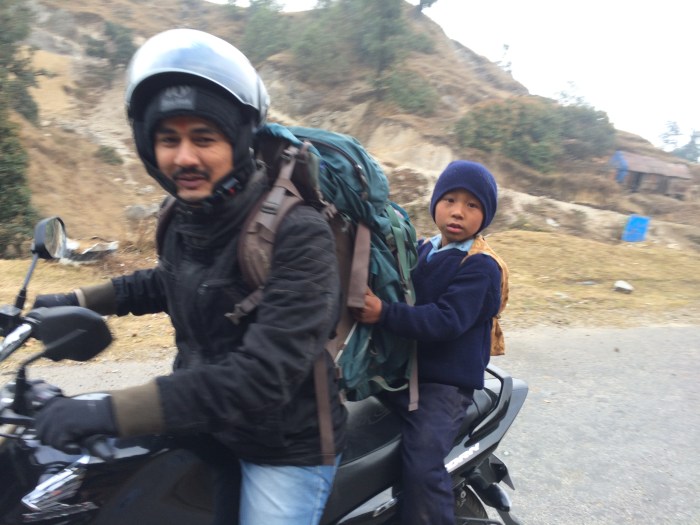
Riding a motorbike is a blast. As our bus was unavailable, traveling to the next school required extended periods of time on the back of a bike.  Ram, Shankar and I traveled like our own bike gang up and down Nepal’s rolling hills admiring the beauty of the changing flora as we rose in elevation. We left the banana trees and jungles and climbed up to various firs and terraced farmlands carved steeply between sparse homes. Even with the wind chill, a huge grin spread across my face as I gave my eyes a mini vacation from the office walls.

As we left a school in Namtar, we invited a young boy to accompany us on the back of the bike rather than walk home.  He, like most others from this school, was mentally preparing for a two hour walk home on the opposite side of the hill. He does this every day. When I was his age I was fighting for the back seat of the bus or waiting from my mom to pick me up from soccer practice. One time I ran home with a friend to her house after school and remember it being brag-worthy – yet that was half the distance this child was traveling.  If we had fuel all three of us would have eagerly been taking trips back and forth that evening.
IMG_8145


Thoughts heading into a new year

Every year around this time I tend to be amazed at how fast time seems to fly.  This year in particular. I’m four month into my fellowship with only 2 more to go. How has this happened so fast? Will time please slow down?

The last week or two has been spent planning my remaining time here in Nepal and reflecting on 2015.  To be frank this is my favorite time of year, specifically for the excuse to lock myself in solitude and spend quality time thinking, reflecting, planning. Some years has started with a spiral of self-pity as I pull up a failed list of goals – didn’t drop the weight, or kick the chocolate habits, or drink less, or do more or give more etc.. But this time around I found a more positive outlook during my self-reflection. Am I finally easing up on myself? Or maybe it’s maturity? Or maybe due to the complete removal of external pressures?  Regardless, the easy forgiveness of shortcomings and recognition of positive aspects to the past year has left a lightness in my soul that I wish I could pour into all of you.

Going with the theme of planning and looking forward, I’ve highlighted many of the concluding plans with the Women’s Protection Center in Nepal in my post below.  I must forewarn that this reads much like a status report [and I think part of me is missing writing them].

During the next two months, we have large goals here at WPC. With our pilot phase completed and materials reworked and finalized, we will be aggressively moving into our delivery phase. Up until this point, I have spent much of my ‘down time’ wandering the populated city of Hetauda, venturing only as far as my legs could take me.  Now we will be reaching the outskirts of the district, working in schools that can only be reached by foot and where overnight accommodations are ‘few and far between’. I’m assuming that means I won’t be collecting Starwood Points so I’m considering packing my tent and newly purchased sleeping bag (shot out to Sonam, I can’t wait to use the lightweight down 15 degree this summer).

We are coordinating with about nine schools for January and 9+ (a to be determined list) for February.  To select locations for our program, we acquired a list of all the government run secondary schools in Makwanpur back in September and built a priority list based on past relationships, geographical proximity and greatest need. The district of Makwanpur is broken up into 46 Village District Communities (VDC’s), each having at least one to two free secondary government schools. With an annual budget of about 25-30 programs a year, we easily have developed a long term plan to accomplish our goal of reaching all Makwanpur.

Thursday will be the first program that will run with our new material. I am SO excited. Can I say that again? So very excited.  Working off feedback from our pilot, we spruced up our original agenda to make time for more interaction and group discussion.  My goal is to ensure we hear the voices of the students rather than simply social preaching and hoping something sticks. This will be done through case studies, discussion questions, and brainstorming sessions. And to the West Monroe readers – we also added, believe it or not, a survey, to provide students the opportunity to share their thoughts on the program and hear additional ideas for future improvement.

Within the program there are three different stories that we profile, all from girls within our home, to describe the harms of child abuse, discrimination and child trafficking. Each story is impactful, saddening me each time I polish those particular slides. We share the story of Asha* who’s dad would beat her and burn her with cigarettes after drunkenly stumbling home from his 12 hour shift as a rickshaw driver. Pemba* who was raised to believe she was worthless and stood no chance at having a future because of the ‘untouchable caste’ she was born into. And Gita* who was approached by a family friend with promises of a better life and offered to help her obtain a visa to work abroad.  Gita’s situation perfectly highlights the power of awareness as his proposition triggered her memory from a past program she attended and ultimately protected her from unknowingly entering an agreement into sexual labor. It’s somber stories such as these that confirms each day spent here is working towards something greater, in a country that so desperately needs a light. (*Names are changed)

My remaining time spent at the office will be dedicated to creating a financial management and business basics course for our students graduating from our vocation training this February. The idea of our program is to add some additional training to teach the women about different work options, the skills involved, and basics of finance. We will also add content to cover entrepreneurism and how to start their own shop in Makwanpur.  Next week, I’m going to host a couple interviews with local women to start my research. At the completion of their six month training program, the graduating students will be asked to demonstrate their sewing craftsmanship and upon obtaining passing marks will receive a certificate of completion.  With this certificate, the women will be highly marketable and able to apply for work as a seamstress, one of the primary sources of income for Nepali women.

Certificates in Nepal are rather symbolic towards their changing society and are held in high regard, often framed like a diploma you would find in a doctor’s office.   Here, it’s a symbol for intellect and economic independence.  When applications are submitted for a new job, the applicant will submit a stack of their certificates illustrating their life’s achievements dating back to their graduation from secondary school. The pride tied to receiving a certificate is understandable when you consider that Nepali citizens have only been allowed to attend school since 1951.  Prior to the 50’s schooling was reserved only for the royal family.

Comparably, at this time in the United States, schools were about to be desegregated from the Brown vs Board of Education trials and children were reading the recently published “The Catcher and the Rye”.  The fact that Nepal is only educated to the second/third generation is apparent now more than ever as the country seems to be splitting at the seams from one crisis after another.  From an outside perspective, a lot of pressure resides on the younger generation to compensate for their populous expansion and infrastructural weaknesses. Even the basics like roads, water supply and consistent electricity are severely lacking….

Although, I must say the lack of electricity and continual supply of internet has been such a blessing.  You know when you go on vacation and bring a book or two to read? Well in this comparison, I’m basically on a six month vacation with endless books available by download (properly timed of course). Currently I’m starting a new one on building character.  My take-a-way thus far is that character is individually defined deeming it necessary to have introspective conversations to understand what define yours, reflecting on the traits you value in people you admire sprinkled with common trends influenced by societal pressures and cultural expectations. Stepping into 2016, will venture to explore what changes I need to make to live in a way that uplifts said values.  Maybe that’s what I’m doing now? We shall see.

Stopping here before this turns into a full blown journal entry. Happy 2016 Friends, Family and the Unknown.