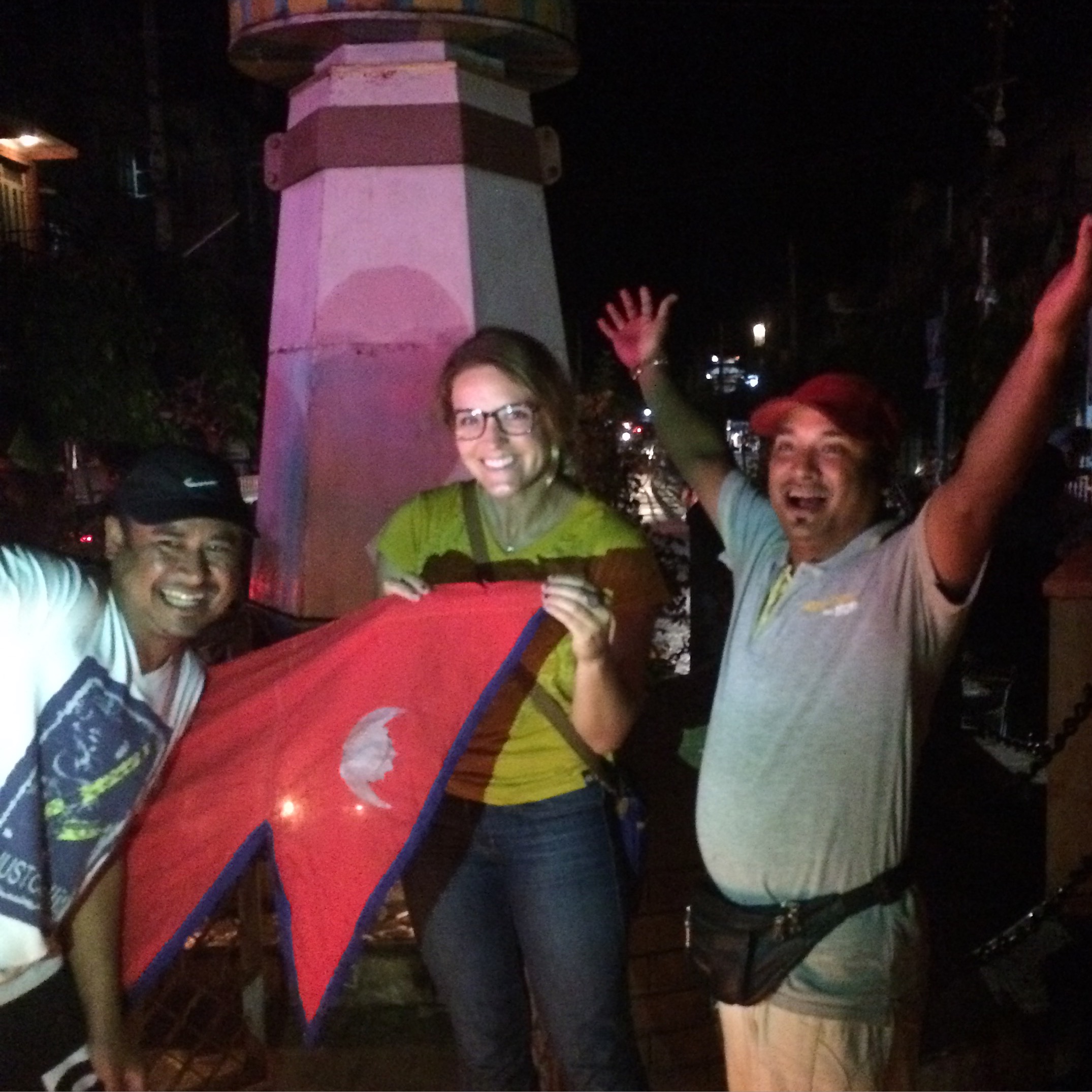
Lightly covered in the US news, Nepal experienced a monumental moment in their history yesterday. After many years of development and revisions, Nepal has finalized a constitution, the first one in place since discussions began in 2006. The majority of Nepal is in support of the new legislature and welcome the change. The streets were filled with people singing, dancing, and lighting candles to demonstrate their support.
 .
. 
To accompany this event, I’ve provided a quick history lesson (hopefully depicted accurately) cultivated through conversations, local news and online research:
In the mid 90’s, a rebel group known as the Maoist formed in the jungle of Nepal and was slowly gaining followers through force and aggression. This group is considered a communist organization and was feared throughout Nepal. I was told a story where the Maoist would come into a remote village and basically tell residents that they had to convert to Maoist or die. As the Maoist gained power, they slowly infiltrated the political parties and initiated a 10 year civil war.
On June 1st, 2001, Nepal experienced a national tragedy. Price Dipendra murdered his entire royal family, in an event called The Nepalese Royal Massacre. Although this event was documented as a family dispute, many locals and undocumented opinions will share this the Maoist group was behind this event. For the next 5 years, Nepal was ruled by the kings remaining brother, Gayendra, who made a political mess of things. During this time the parliament was dissolved, claiming they were incapable of handling the Maoist rebels. As a result, 3 different political parties formed with hopes of establishing power for the people, eliminating the martial law currently in place. This included the Maoist, Communist Party of Nepal, and the Nepali Congress. In 2008 the three parties successfully abolished the monarchy and established a federal republic, led by a president and prime minister.
The frequent governmental upheavals has left the country govern-less, individually abiding by the rules of their diverse religions rather than a centralized government. The is a saying that goes “this is Nepal, I do whatever I like”. The political leaders and Brahmin caste have complete control of judicial decisions, leaving the people with little to no control of their judicial fate.
This brings us back to the constitution.
So since 2006, the three political parties have been working side by side to come up with an agreement that provides power to the people and moves towards a federation and democratic governmental rule. Despite some hesitations that I will get to next, the agreement that is now in affect includes numerous progressive steps in the right direction, and as the current (now retired) president explains, can be amended with 2/3’s majority rule. With a constitution in place, simple legislature that we take for granted, are now defined, like terms of citizenship and core freedoms. It also defines governmental structure and processes.
The major change is the creation of 7 states, separating Nepal into geographic regions with providence specific governmental power. In addition, the constitution stresses inclusion despite diversity, and provides the following freedom of opinion and expression, of assembly peacefully and without arms, to form political parties, unions, and associations, to move freely amongst Nepal, and to partake in any organization. It also defines citizenship, provides women equal parental rights, the right for a lawyer, outlaws torture and detention, etc. etc. etc. There are also a few articles included related to my mission in Nepal:
- Article 34. Rights against exploitation:
- (1) Each person shall have the right against exploitation.
- (2) No person shall be subjected to any kind of exploitation on the basis of religion, custom, tradition, culture, practices or any other bases.
- (3) No person shall be subjected to human trafficking or bonded labour, and such an act shall be punishable by law.
- (4) No person shall be subjected to forced labour. Provided that nothing in this sub-clause shall prevent the enactment of a law requiring citizens to be engaged in compulsory service for public purposes.
- (5) Any act contrary to sub-clause (3) and (4) shall be punishable by law and the victim of such an act shall have the right to appropriate compensation from the perpetrator.
- Article 36. Rights regarding education:
- (1) Every citizen shall have the right to access to basic education.
- (2) Each citizen shall have the right to compulsory and free basic education, and free education up to the secondary level.
- (3) The physically impaired and citizens who are economically very poor shall have the right to free higher education as provided for in law.
- (4) The visually impaired shall have the right to free education with the medium of brail script. Citizens with hearing impairment and speech impairment shall have the right to free education with the use of sign language.
- (5) Every Nepali community living in Nepal shall have the right to acquire education in its mother tongue up to the secondary level, and the right to open and run schools and educational institutions as provided for by law.
- 43. Right of women:
- (1) Every woman shall have equal right to lineage without any gender discriminations.
- (2) Each woman shall have the right to safe motherhood and reproductive health, and infanticide on the basis of identity of gender shall be punishable by law.
- (3) There shall not be any physical, mental, sexual or psychological or any other kind of violence against women, or any kind of oppression based on religious, social and cultural tradition, and other practices. Such an act shall be punishable by law and the victim shall have the right to be compensation as provided for in law.
- (4) Women shall have the right to access participate in all state structures and bodies on the basis of the principle of proportional inclusion.
- (5) Women shall have the right to special opportunity in the spheres of education, health, employment and social security on the basis of positive discrimination.
- (6) Both the spouses shall have equal rights in property and family affairs
- 44. Rights of children:
- (1) Each child shall have the right to his/her identity with the family name, and birth registration.
- (2) Every child shall have the right to education, health care nurturing, appropriate upbringing, sports, recreation and personality development from family and the State.
- (3) Every child shall have the right to formative child development, and child participation.
- (4) No child shall be employed in factories, mines, or in any other hazardous works.
- (5) No child shall be subjected to child marriage, illegal trafficking, kidnapping, or being held hostage.
- (6) No child shall be subjected to recruitment or any kind of use in the army, police or armed groups, neglected, or used immorally, or abused physically, mentally, or sexually, or exploited through any other means, in the name of religious or cultural practices.
- (7) No child shall be subjected to physical, mental, or any other forms of torture at home, in school, or in any other places or situations.
- (8) Every child shall have the right to child friendly justice.
- (9) Children who are helpless, orphaned, physically impaired, victims of conflict and vulnerable, shall have the right to special protection and facilities from the State.
- (10) Any act contrary to Clause (4), (5), (6) and (7) shall be punishable by law, and children who have suffered from such an act shall have the right to be compensated by the perpetrator as provided for in law.
I have observed that the US news has mostly focused on the negative aspects of the constitution. Yes, there are certain minority groups that are very much against the constitution and do not feel that they are adequately represented, particularly when it comes to the electoral college representation of the more remote states. There is also a general concern that there is no clear implementation plan and are unsure what next steps will be taken to execute changes like expanding free education. Personally, I feel that this was a step towards resolving one of Nepal’s primary issues, lack of political definition. With the new constitution in place, men, women, and children of all castes, ethnicities, sexual orientation, and religion are protected alike, providing ground rules that are ready for future expansion.
Over the next month, political elections will occur. In the new government, the previous president and prime minister will step down, making space for The Federal Democratic Republic of Nepal to start fresh. The president will be elected to a 5 year term by the voting members of the federal parliament. Unlike the US, only members can vote. Speculation has guessed that the leader of the Maoist party, Pushpa Kamal Dahal will be elected, granting him control of the Nepali army. Despite the Maoist violent history, hope remains that the future constitution will lead Nepal towards equality amongst its diverse nation.
One of the things I have enjoyed so far is having time to read the morning Himalayan Times, delivered directly to the safe home with my morning Chiya. This topic has been heavily covered and I’m sure will remain front page news has reactions to the recent formalization and implementation of the constitution. Looking forward to what happens next…
 Journeying Jennifer
very interesting information and appreciate having a reliable source providing.
LikeLike
wow it’s amazing the timing for you to be there to witness this possibility of change. The articles you listed above is your heart for the woman and children. All I can say is wow thank you God for your timing.
LikeLike
Each morning I look forward to another Journey with Jennifer to enjoy with my coffee
LikeLike
Thanks for the motivation to get my next post out. Love you 🙂
LikeLike